In a year that has seen foreign equities ETFs stand out so strongly, emerging markets may be somewhat underrated. Broad, global equities strategies — especially those that exclude U.S. firms — have done very well as investors have looked abroad to diversify.
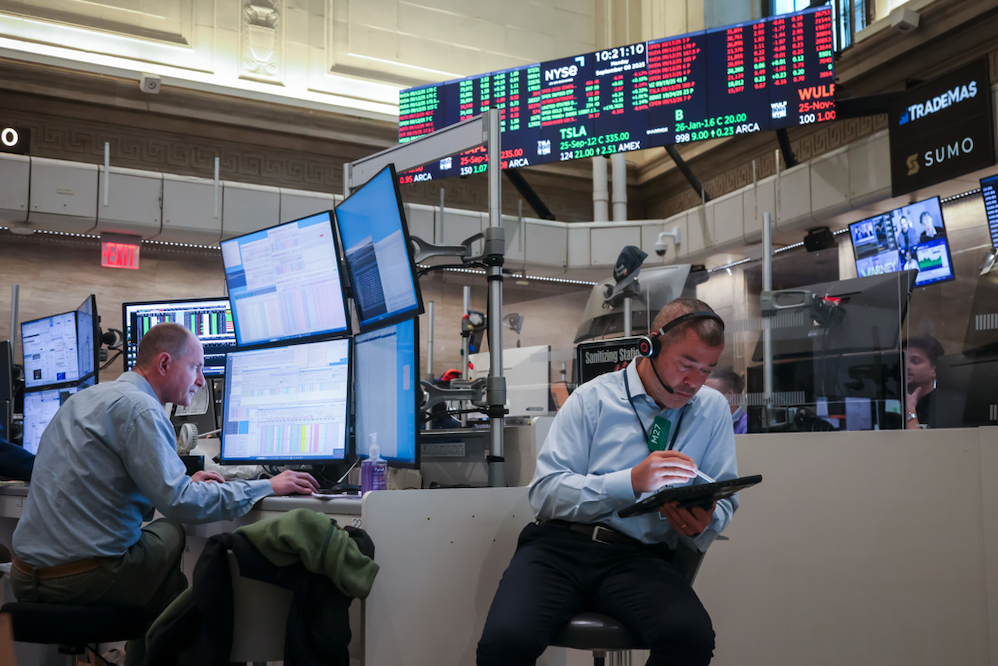
Wall Street traders gearing up for the Federal Reserve decision refrained from making big bets as they awaited clues on the path of rates that will shape the outlook for markets over the next few months.
Technology has made customization operationally viable across entire books of business. But the real opportunity lies in how it reshapes the advisor/client relationship. When complexity is handled behind the scenes, advisors can focus on deeper conversations, clearer guidance, and lasting alignment.
In spite of what appeared to be relatively good data, many polls throughout the 2024 election cycle showed more than half of all voters rated the economy as “poor.” That left the Biden/Harris team often wondering why they couldn’t get credit for what official statistics said was a robust economy.
Gold mining equities are having a blockbuster 2025. Prices for the precious metal have hit one all-time high after another, and the miners who pull it from the ground are rewarding investors with some of the best returns in the market today.
VettaFi’s Head of Research Todd Rosenbluth discussed the Thornburg Multi Sector Bond ETF (TMB) on this week’s “ETF of the Week” podcast with Chuck Jaffe of “Money Life.”
For investors who want some chaos protection, something in their portfolio that’s not correlated to U.S. or developed market stocks and bonds, a managed futures strategy could be the ticket.
Until this year, U.S. stocks had consistently been the best-performing asset class over the past 15 years, so diversification did not work. And as a result of that runup, the U.S. stock market became very expensive. However, this year, diversification outside the U.S. into foreign stocks has added value, and gold is shining very brightly.
Clients work a lifetime for financial freedom. Once retirement comes, they often have a large nest egg to spend. However, there can also be a huge fear of spending the portfolio down.
Gold rose near a record high as traders geared up for an anticipated easing of the US Federal Reserve’s monetary policy this week and looked for clues on further rate cuts this year.
A key question for investors this week is whether Federal Reserve officials push back against market bets on a series of interest-rate cuts extending into next year.
US equities extended gains early Monday to kick of a high-stakes week for financial markets, with the Federal Reserve largely expected to resume its interest-rate cutting cycle.
No one wants to be a party pooper. It drives away friends and makes you generally unpopular. But if you are a monetary policymaker, ending the party before it gets too wild is quite literally your job.
Last week's economic data presented a challenging picture for the U.S. economy with key inflation reports delivering conflicting signals and a timely labor market indicator added to the narrative of a softening labor market.
In a recent LinkedIn newsletter, we highlighted how mid-caps have historically delivered a compelling mix of growth and resilience, the "sweet spot" between innovation and maturity.
A key theme dominating global financial markets in recent weeks has been the general upward pressure on sovereign bond yields, particularly at the long end of government bond market curves.
It is certainly possible for the Federal Reserve, as the biggest player on the block, to lower money market rates over the course of the next few meetings. However, if it turns out to have been orchestrated out of political expediency rather than as stimulation for a weak economy, inflation will result. We saw a similar movie in August 1971.
Every time the mainstream declares price inflation dead and buried, new data comes out and rains on the funeral.
The Russell 2000, home to some of the riskiest stocks on the market, has been on a tear — and a spate of Wall Street strategists say the rally is just getting started.
WisdomTree Inc. launched its first tokenized fund that gives investors exposure to private credit, marking the latest attempt by Wall Street to connect fast-growing markets with blockchain technology.
Companies are moving some of the excess cash on their books into longer-term securities, betting that rate cuts from the Federal Reserve will make these holdings more lucrative.
In light of the major market shocks of 2025, advisors are tasked more than ever with helping clients manage the psychological aspects of their money, while keeping an eye on market opportunities and headwinds that can impact their investment portfolios.
US stocks climbed on Thursday, posting fresh records amid hopes that an in-line inflation report will push the Federal Reserve to cut interest rates next week.
BlackRock Inc. is exploring how to give one of Wall Street’s biggest investment products a digital makeover.
The One Big Beautiful Bill Act offers valuable tax benefits specifically for businesses. Our Bill Cass discusses the highlights of the new law and how business owners may benefit.
It’s no understatement to say this could have been the most anticipated jobs report in quite some time.
For much of its nearly 17 years on the market, bitcoin has been viewed as a volatile asset. The largest cryptocurrency’s history is chock full of dramatic price swings in both directions and extended periods of turbulence.
Last week's employment update seems likely to prompt a shift in the Federal Reserve's monetary policy. The August jobs report revealed a significant slowdown, with Nonfarm Payrolls (NFP) increasing by only 22,000, well below the 75,000 expectation from economists surveyed by Dow Jones.
We’ve received many client questions about seasonality in stocks, and specifically about the ‘September Effect’. This is the theory that investors should sell their stocks after Labor Day to avoid autumn volatility.
Assets under management (AUM) by ETFs globally closed at another month-end peak and is now just 6 percent below the all-time high reached during the pandemic.
Markets now see more than an 80% chance of a rate cut from the Fed this month, and it may be a good time to reallocate short-term cash positions to medium-term fixed income positions with maturities between 5 and 10 years.
Before you fully consider purchasing a new ETF, you need to understand what makes the fund different from what you own.
One of the standout developments in financial markets in August 2025 was the unprecedented surge in ETF inflows.
Emerging markets are becoming more attractive as the prospect of an upcoming US rate cut — combined with softer local inflation and relatively low public debt — strengthens the investment case, according to Navin Hingorani, Singapore-based portfolio manager at Eastspring Investments.
The third Friday in September is a special day in the financial-market calendar. It’s one of the four days a year the S&P 500 index gets rebalanced. With over $10 trillion of assets passively tracking it, the exercise will affect markets and investors in every corner of the world.
Technology stocks are rising so far, so fast that some investors are starting to position for the move to lose momentum.
There has not been a fundamental innovation in broad-market cap-weighted indexing in decades. Until now. With the Research Affiliates Cap-Weighted Index (RACWI), we introduce a fresh approach designed to fix a costly but little-known “bug” in cap-weighted indexing.
Markets cheered an imminent Fed rate cut, with small caps outpacing the S&P 500, but rising unemployment, sticky inflation, and slowing job growth point to stagflation risks. Advisors face a market both buoyed by near-term catalysts and shadowed by longer-term vulnerabilities.
Making the case for potential rate cuts in his recent speech at Jackson Hole, Fed Chair Powell noted that policy is presently in restrictive territory.
Although the relationship between fundamental returns and total returns after a decade is solid, valuations do matter – their impact is evident in the vertical distance between each stock observation and the diagonal line on the chart.
Private equities are a growing and increasingly significant part of the investing landscape.
DoubleLine CEO/CIO Jeffrey Gundlach, widely known in the capital markets as the "Bond King," spoke at a Total Return Webcast.
The U.S. labor market continued to show signs of cooling, with all major labor indicators pointing to a softening trend and a weak hiring environment. Read through the major economic news from the week of September 2nd - 5th.
Investors are leaning into bullish bets on US Treasuries ahead of this week’s inflation report, as a recent run of softer-than-expected data opens the door for the Federal Reserve to cut interest rates in September and further ease monetary policy in the months ahead.
Oracle Corp. is set to vault past stocks such as JPMorgan Chase & Co. to become the 10th most valuable member of the S&P 500, after a blowout cloud business forecast sent its shares soaring.
Market uncertainty continues to linger in the back of fixed income investors’ minds. But that can force much-needed recalibration of portfolios as tariffs and rate cuts loom. A compelling option to consider: corporate bonds.
The rise of private markets has brought new attention to private investment grade (IG) credit, which can offer investors a premium over public IG for giving borrowers customized terms – though that premium comes with certain risks.
Surface-level diversification is no longer enough in a market increasingly driven by passive flows and dominated by a few mega-cap names. Owning multiple funds or asset classes does not guarantee protection if the underlying exposures overlap. Investors must go deeper and look beyond labels and into the actual drivers of risk and return.
Healthcare has been the worst-performing sector in the S&P 500 so far this year.
Ben Fulton, CEO of WEBs Investments, highlights the firm’s suite of Defined Volatility ETFs, which dynamically adjust equity market exposure based on real-time market volatility. Arthur Nowak, Client Portfolio Manager at Alger, discusses the firm’s high-conviction approach to investing in innovation and growth – including the Alger AI Enablers & Adopters ETF (ALAI).