The summit in Beijing between US President Donald Trump and Chinese President Xi Jinping delivered little in the way of diplomatic breakthroughs but bears important cross-asset implications.
As Kevin Warsh takes over as Federal Reserve chair with his own goals, he may face challenges even beyond rate policy, from inflation to independence to a bulbous balance sheet.
Chemistry is a vital component when building an organizational powerhouse. This applies not only to just sports, but also the executive world. In the NBA, the New York Knicks assembled the “Nova Knicks.” This effectively reunited a championship-caliber core of Villanova alumni in Jalen Brunson, Josh Hart, and Mikal Bridges.
Leadership transitions at the Federal Reserve (Fed) are rare. Only seven individuals have served as Fed chair since the 1970s, underscoring how infrequent turnover is at the Fed’s top job. That rarity is why investors pay close attention when a new chair is appointed, especially when the incoming leader brings a different perspective. Kevin Warsh has been a vocal critic of Fed policy and communication in recent years.
The sooner the mass of retail private credit managers realize they are zombies and give up the ghost, the sooner we can burn the whole thing to the ground and conjure a better model from the ashes. But there is no time like a crisis to have conversations about how to make the structure work better for everyone in the future!
Semiconductor stocks, along with some computer hardware companies, are the market’s latest AI darlings. Momentum and gamma are driving the outperformance, and, in their wake, a supportive narrative is trying to justify it.
In this episode of "ETF of the Week," Todd Rosenbluth (Head of Research at VettaFi) joins Chuck Jaffe to dive into the Roundhill Memory ETF (DRAM). Launched in April 2026, this fund has shattered records, amassing over $6 billion in assets in just over a month.
Investors were forced to pay attention Friday, when the most interest-rate sensitive corners of the market saw big plunges in an ugly market selloff. The small-cap Russell 2000 Index dropped 2.4% for the biggest single-day decline since November.
Yields on US bonds dipped as much as three basis points Monday after Iran’s semi-official Tasnim reported that Washington proposed a temporary waiver on Iran oil sanctions until the final agreement, citing a source close to the negotiation team.
In the race to build the infrastructure that powers artificial intelligence, Alphabet Inc.’s Google has an enviable position: The company has a healthy cloud computing business, makes its own chips, and has struck deals to share them with companies like Anthropic PBC and Meta Platforms Inc.
Against this challenging macro backdrop, a stark divergence is expected as major retailers report earnings next week. Discounters are projected to perform well, with Walmart (WMT) expected to outpace Target (TGT) by gaining market share from high-income households trading down for groceries, while Target remains more vulnerable due to its heavier mix of discretionary goods.
The stagflation narrative dominating financial social media isn’t completely wrong. That’s what makes it so dangerous. After more than 30 years of managing client portfolios through actual inflationary cycles, not watching them on YouTube, I’ve learned that the most damaging investment advice isn’t built on outright lies.
US equities continue to march higher in 2026 despite geopolitical uncertainties, supported by resilient economic data and strong corporate earnings. Much of the market narrative remains focused on mega-cap technology and artificial intelligence (AI).
In our Q2 Equity Market Outlook, we identified healthcare as one area where artificial intelligence (AI) is having tangible benefits and presenting investors with new expressions of the AI investment theme. While healthcare may glean some luster from an AI halo, the investment case is also one of counterbalance to the AI juggernaut.
Emerging markets bonds and the related ETFs are delivering for investors. Meanwhile, other, supposedly more dependable, less risky corners of the bond market are dithering. Market participants can capitalize on that trend with the VanEck Emerging Markets Bond ETF (EMBX), which is coming off an impressive showing last month.
The U.S. economic landscape in April was defined by a significant rebound in inflation across both consumer and wholesale sectors, complicating the path for future monetary policy.
The United States has not felt the greatest costs of the Iran conflict, but challenges are becoming visible. Energy prices have risen, with limited prospects for relief. Inflation measures are poised to spread to other product and service categories. Inventories that helped to blunt the impact are depleting; supply chain distortions are accumulating.
David Mann, our Head of Global Exchange-Traded Funds (ETFs) Product and Capital Markets, explains how meatloaf—the dish, not the singer—serves as a perfect example of how his ETF thinking has evolved over the past decade.
ClearBridge Investments: The ongoing energy crisis is pushing global oil inventories, including many critical product inventories, toward all-time lows, and it may be time to position portfolios given the potential for supply shortages to emerge.
Explore how Women in ETFs & CFAOC experts believe AI will supplement, not replace, financial professionals.
America is fast becoming a country with two economies: a stagnant one for men and a growing one for women. So far this year, the US has created more than 165,000 private-sector jobs, and 72% of them went to women. To some extent this reflects a structural change in the economy, as growth is in industries more likely to employ women, such as healthcare.
Rising bond yields curbed traders’ appetite for risky bets early Friday, sending stocks lower following a weeks-long record-setting rally driven by a rush of cash into all things artificial intelligence.
Investors shed government bonds around the world, propelling borrowing costs to multi-year highs from Japan to the US amid intensifying fears that war-driven inflation will force central banks to pursue higher interest rates.
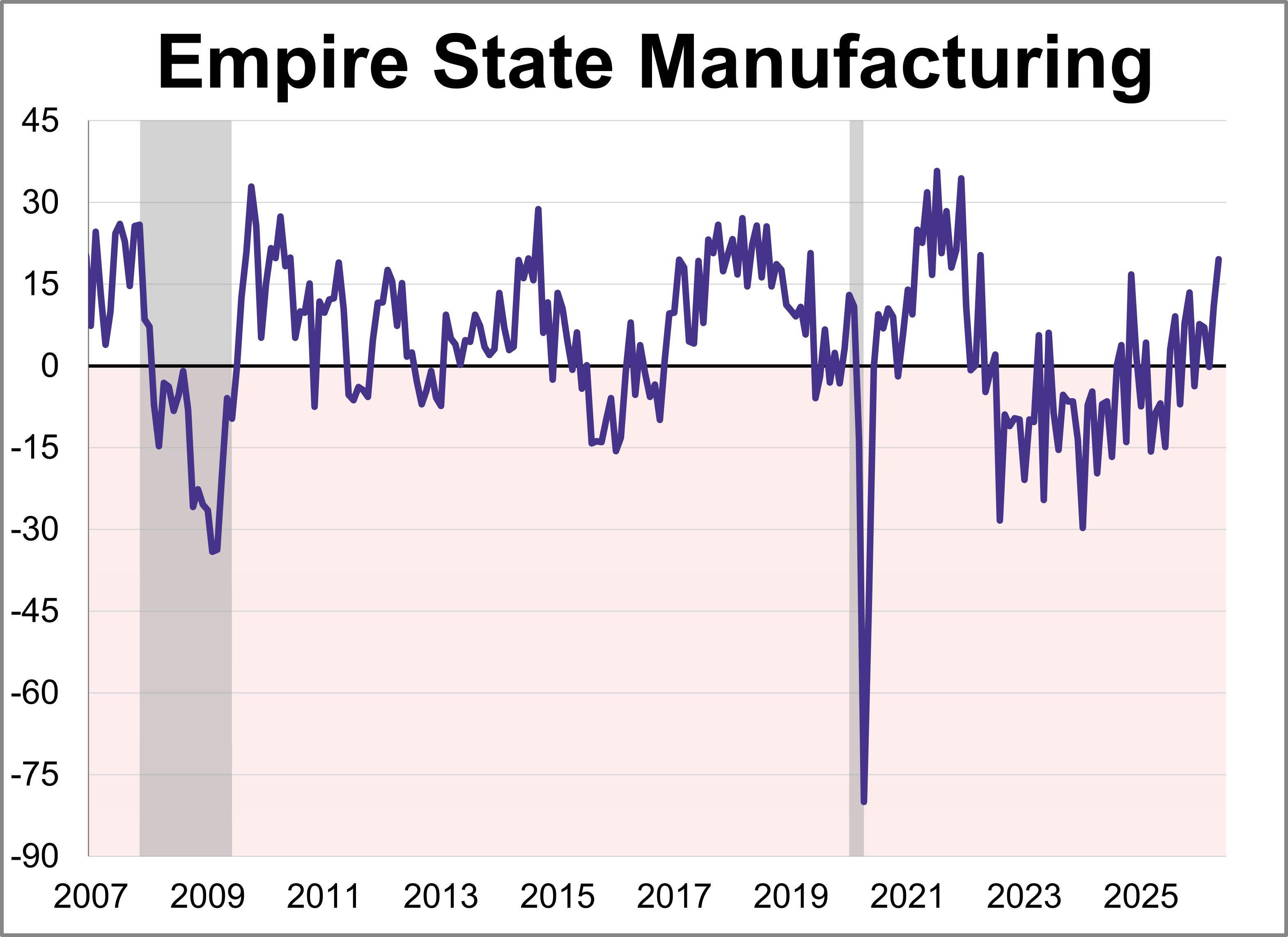
Manufacturing activity grew strongly in New York State, according to the Empire State Manufacturing May survey. The diffusion index for General Business Conditions rose 8.6 points to 19.6, its highest level in over four years.
AI is surely the zeitgeist at industry conferences across sectors right now. Emerging technology, increased efficiency, and scalability are all talking points. But so too are headcount reductions, reduced tech-sector free cash flow, and growing worries about a 1990s-like bubble.
Investing in emerging markets (EM) used to be synonymous with getting exposure to China. It’s an ideal notion, given that it’s the second largest economy and thus commands a heavy weight in standard EM benchmarks. Challenging that narrative today is a changing geopolitical landscape, which continues as U.S. president Donald Trump visits China in a high-stakes meeting between the two economic superpowers.
There is a big difference between betting on something and investing in meritorious companies with long holding periods. Although we are no longer shareholders of Berkshire Hathaway, Warren Buffett shared some wisdom with everyone recently.
Silver may help efficiently produce hydrogen for use as a power source. Not only is hydrogen clean-burning – leaving only water – but it is easier to store and transport than petroleum-based fuels. Conventional methods of producing hydrogen, such as steam methane reforming (SMR) or water electrolysis, have disadvantages that silver may help to overcome.
Yields for preferred securities have generally risen more than corporate bond and long-term Treasury yields over the past few months, making them more attractive to investors.
Stock markets have been hitting all-time highs and credit spreads remain low, yet higher interest rates and mounting floating-rate debt are straining lower-rated borrowers. This tension is surfacing first in leveraged loans as “quiet defaults” become more common — opening up a dynamic set of opportunities for investors specialized in stressed and distressed assets.
Semiconductors and software have largely overshadowed the electrification ETF trade. Paul Baiocchi, head of fund sales and strategy at SS&C ALPS Advisors, says most investors are missing the sectors that actually power the AI buildout.
Investors and advisors often seek private equity, but they are frequently thwarted by liquidity and other issues.
Top RIA executives said Tuesday the industry's growth is still early, with breakaway clients and a talent shortage as key forces.
GraniteShares and VettaFi are bringing together the experts to demystify autocallable and barrier ETFs: how they generate superior income, how barrier levels protect against the downside, and exactly how they fit into a modern income strategy.
Apollo Global Management Inc. announced last week that it will soon provide daily pricing for its private credit. It may not sound like a big move, but its decision to lift the veil on these assets could be the most impactful development in financial markets and investing in a long time.
April delivered a constructive backdrop for preferred securities, with the ICE BofA Fixed-Rate Preferred Securities Index rebounding 2.23% and bringing YTD returns back into positive territory at 0.8%.
Artificial intelligence (AI) leadership is no longer a developed-market monopoly. Emerging markets (EM) now have their own AI champions, and productivity gains may follow. For bond investors, we expect the implications to differ by country—driven by industry composition, capital intensity, digital infrastructure and speed to adoption.
Typically, an investor’s traditional bond portfolio begins with a cornerstone, or core holding of some sort. From either a strategic or tactical perspective, a core fixed income position provides the investor with some ballast to help anchor any other strategies that may be included.
Kevin Warsh set to be confirmed as the next Fed chair, Senate committee meets to consider the CLARITY Act, President Trump heads to China, and the gerrymandering wars heat up.
With inflation persistent and rising due to soaring energy prices, it’s not surprising that advisors and fixed income investors are revisiting Treasury Inflation-Protected Securities (TIPS). In fact, data indicate that inflation-linked bonds have been among the most popular fixed income destinations, dating back to 2022.
The ETF landscape is ever changing, and has grown massively since the ETF rule arrived in 2019. It was the game-changer that streamlined the launch process for new funds, thus allowing asset managers to offer new and innovative strategies in the wrapper.
Andrew Chanin, CEO of ProcureAM, and Paul Baiocchi, head of fund sales and strategy at SS&C ALPS Advisors, joined Nate Geraci on this week’s ETF Prime to discuss specialized thematic opportunities. The Procure Space ETF (UFO) has grown from $50 million to over $800 million in assets over the past year while gaining nearly 150% in the same period, according to Chanin.
Goldman Sachs Group, Inc. (GS) executives detailed their artificial intelligence strategy for operational efficiency as new data showed the top 100 registered investment advisor firms now manage more than $1.6 trillion in client assets, double what they controlled just two years ago, according to Padi Raphael, global co-head of third party wealth at the firm.
Fears of hotter-than-expected inflation were realized today. Consumer Price Index (CPI) data revealed that headline CPI rose 0.6% month-over-month in April. This pushed the year-over-year figure to 3.8%, which constitutes the highest reading since May 2023. To beat the CPI heat, three distinct natural resource ETFs offer varying ways to hedge against higher inflation.
To understand the full impact of AI on advisor productivity, it’s important to look beyond speed alone. The more relevant question is whether efficiency gains are creating meaningful breathing room or simply raising expectations and expanding the scope of work.
The nuclear power industry is booming. With electricity demand surging, dozens of nations have set a goal of tripling the world’s capacity by 2050. And the US, which has the biggest fission fleet, is pushing to quadruple output from its reactors.
Alphabet Inc.’s Google introduced a new high-end laptop segment called "Googlebook" that will run Android and prominently showcase Gemini artificial intelligence. Hardware partners Dell Technologies Inc., Lenovo Group Ltd. and HP Inc. will debut models built on the platform in the coming months.
A real fundamental story doesn’t require a parabolic chart to validate it. In fact, fundamentals tend to drag prices up the trend line, not push them through the ceiling. When a “shortage” narrative arrives at the same moment that the worst-quality names in the sector are leading the index higher, that’s not fundamentals at work.
Within private credit, attempts to increase liquidity – the ability to buy or sell an asset quickly, in size, and at prices reflecting fundamental values – are welcome developments, in our view. Yet until these efforts address the market’s inherent structural constraints, including a lack of true price discovery, they will only increase the perception of liquidity without truly improving liquidity.
Get ready each week with high-conviction insights that go beyond media headlines.