In today’s market, income investors remain firmly focused on one objective: yield. With traditional sources of income still under pressure, demand for high-income ETFs continues to grow — especially those capable of delivering consistent monthly payouts.
The Pentagon has struck agreements with four more technology companies for expanded use of advanced artificial intelligence tools on classified military networks, according to a Defense Department statement and two defense officials briefed on the matter.
Volatility ETFs have specific purposes to fulfill for investors -- so have they done so in a very volatile year?
Core aggregate benchmarks remain the bedrock of many fixed income portfolios but advisors are increasingly looking to income alternatives.
Join the experts at WisdomTree for an educational webcast exploring how an efficient core can add diversification without compromising on the essentials.
The Institute for Supply Management (ISM) manufacturing purchasing managers index (PMI) came in at 52.7 in April, unchanged from March and marking the fastest expansion for the index since August 2022. The latest reading was lower than the 53.1 forecast and is the index's fourth straight month in expansion territory.
U.S. manufacturing hit a nearly four-year high in April, as the S&P Global PMI climbed 2.2 points to 54.5. This expansion was largely driven by defensive stockpiling as companies braced for supply disruptions and price hikes linked to conflict in the Middle East.
The 10-year Treasury yield has experienced dramatic fluctuations, ranging from a peak of 15.68% in October 1981, during the height of the Volcker era, to a historic low of 0.55% in August 2020, amidst the economic uncertainty of the pandemic. At the end of April 2026, the weekly average stood at 4.30%.
President Donald Trump will sign an executive order aimed at expanding access to retirement plans for workers whose employers don’t offer that benefit, according to a White House official, a bid to refocus the administration’s messaging on economic issues.
Global risks have tilted against both growth and price stability. The ceasefire in the Middle East has brought a measure of calm to financial markets, but it has not resolved the underlying economic shock. With the Strait of Hormuz effectively shut, supply constraints continue to ripple through energy markets and are increasingly spilling over into downstream sectors.
The stock market would love to see nothing more than the labor market holding up. Time and again, we find monetary policy having a beautiful, lagged effect in the jobless claims series. We are of the view that the cumulative 175 basis points of Fed rate cuts that hit the market in 2024 and 2025 is exactly what the labor market needs in 2026-2027. We will soon find out if manufacturing employment continued to mend in April.
The OpenAI bubble was inflated thanks to the company’s first-mover advantage from the almost accidental success of ChatGPT. That launch, OpenAI’s first huge viral moment, made it the fastest-growing consumer tech product in history — 100 million users within two months. Extraordinary sums of venture capital followed, and the company is now worth $852 billion. Quickly placed on its shoulders was the fate of the industry.
The sharp rebound from the March lows has pushed most major equity indexes back to record highs. This upside momentum has been fueled in part by signs of de-escalation with Iran and growing expectations that the Strait of Hormuz could reopen soon.
When Jamie Dimon turned to competitive threats in his shareholder letter this year, the chief executive officer of JPMorgan Chase & Co. did something unusual: He named some. Citadel Securities LLC and Revolut Ltd. were two of the firms Dimon picked out.
Where should advisors and investors be looking to find the best opportunities in fixed income? Given the current macroeconomic picture, now is certainly a good time to consider shifting one’s fixed-income portfolio.
Markets and observers weren’t surprised when the Federal Reserve held its policy rate steady at the April meeting. More notable, in our view, were the three dissents by voting participants who did not support keeping the implicit easing bias in the policy statement’s forward guidance language.
Eli Lilly & Co. surprised Wall Street by raising its annual sales and profit forecast, as demand for obesity medications soared and thousands of patients started taking its new weight-loss pill before advertising for the drug had even begun.
International deep value stocks are a high-conviction, active position across all GMO Asset Allocation portfolios. We define the deep value group of securities as the cheapest 20% of the market, a broad opportunity set that allows us to construct portfolios that are cheaper than traditional value indexes but still high in quality.
The AI hyperscalers are lumped together for obvious reasons, but after the four largest reported their earnings on Wednesday night, it became abundantly clear that one of these big-spending giants is not like the others.
Geopolitics – beyond the Fed’s control – have added to economic uncertainty and cloud the outlook as Fed Chair nominee Kevin Warsh (who this morning won the backing of the Senate Banking Committee and will now head to the Senate for final confirmation) looks almost certain to take the reins in just over two weeks.
The European Union (EU), pursuing ambitious decarbonization goals, is significantly recalibrating its emissions compliance regime with the Carbon Border Adjustment Mechanism (CBAM). This new border tax intends to promote fair competition amid varying emissions rules and costs. Our research suggests it could also offer insight into profitability as the rising costs to meet carbon limits weigh on corporate financial health, creating winners and losers.
Days before his first annual meeting as the chief executive officer of Berkshire Hathaway Inc., Greg Abel is facing a problem that seldom confronted his legendary predecessor: a floundering stock price.
As widely expected amid rising oil, rates will remain 3.5% to 3.75%. However, four policymakers dissented. And Fed Chair Powell will stay as governor after his chairmanship ends.
In a recent (unscientific) Franklin Templeton social media poll, we asked investors what they felt was the biggest risk to the global economy over the next 12 months. Nearly half (45%) of respondents highlighted high oil prices as their greatest fear factor.
As multi-asset income investors, we seek to help a wide range of clients meet their income needs. The benefits of an income-centric approach are especially relevant for investors as they enter retirement – and that’s especially true today. We bring that to life with two case studies.
The rapid institutionalization of the $3 trillion private credit market has left many financial advisors racing to catch up. While the asset class was once a walled garden for pension funds, the mainstreaming of private debt requires a new level of diligence and education. The shift toward transparency is finally allowing advisors to look under the hood of these complex structures.
Applications for US unemployment benefits plunged to the lowest level in decades, a sign that job-cut announcements have not yet meaningfully translated into layoffs.
Participants will gain a deep understanding of the macroeconomic drivers shaping the next three months. We will move beyond the headlines to provide actionable insights on portfolio construction, risk mitigation, and identifying value in an environment characterized by both transition and opportunity.
Inflation-adjusted gross domestic product increased an annualized 2% in the first quarter after the longest-ever federal government shutdown limited growth in the closing months of 2025, according to an initial estimate issued Thursday by the Bureau of Economic Analysis.
Meta Platforms Inc. is looking to sell between $20 billion and $25 billion of investment-grade bonds, according to people with knowledge of the transaction, as the Facebook parent boosts spending on infrastructure for the artificial intelligence boom.
Treasury Inflation-Protected Securities, or TIPS, can help buffer a portfolio against inflation. However, it's important to understand their unique characteristics and complex nature.
The stakes for OpenAI are existential at worst and a serious burden at best as it seeks to go public. In preparation, the company has taken spring cleaning to the next level — embarking on a culling of “side quests” like the video creator Sora, ending some science research and even putting on hold its plans for an erotic version of ChatGPT.
For much of 2025, the U.S. dollar looked vulnerable: expensive, less supported by the exceptionalism narrative and heading toward a weaker regime. Then the war in the Middle East changed the picture. Energy prices rose, risk sentiment shifted and the dollar reclaimed its safe-haven role.
Reaching age milestones triggers critical financial and tax-planning actions. This guide explores how specific ages impact decisions regarding Medicare, Social Security, charitable giving and retirement withdrawals, helping you navigate these milestones to optimize your long-term wealth strategy.
The long-term shift from traditional pensions to defined contribution (DC) plans puts employees in charge of their retirement savings—and needing help.
So the question is not whether innovation can drive growth. It’s how much growth innovation can drive. The falling population and heavy debt load mean productivity will need to increase GDP by at least 2.5%, maybe 3% depending on the path of interest rates.
For years, Warren Buffett shaped the meeting into something closer to a macro forum layered atop a company update. His commentary, alongside the late Charlie Munger’s sharp mind and entertaining voice, kept Berkshire stockholders and the investing world glued to TV screens on the first Saturday in May.
In a choppy year for tech investors, one trade has stood out as a success: buy chip stocks, sell software shares. And the divide between winners and losers is getting bigger as 2026 moves along.
Now and then, advisors need to get a sense of how Americans of all ages approach retirement planning. Back in March, Fidelity Investments released its 2026 State of Retirement Planning Study. The report took a deep dive into how different age groups of Americans are viewing retirement preparations.
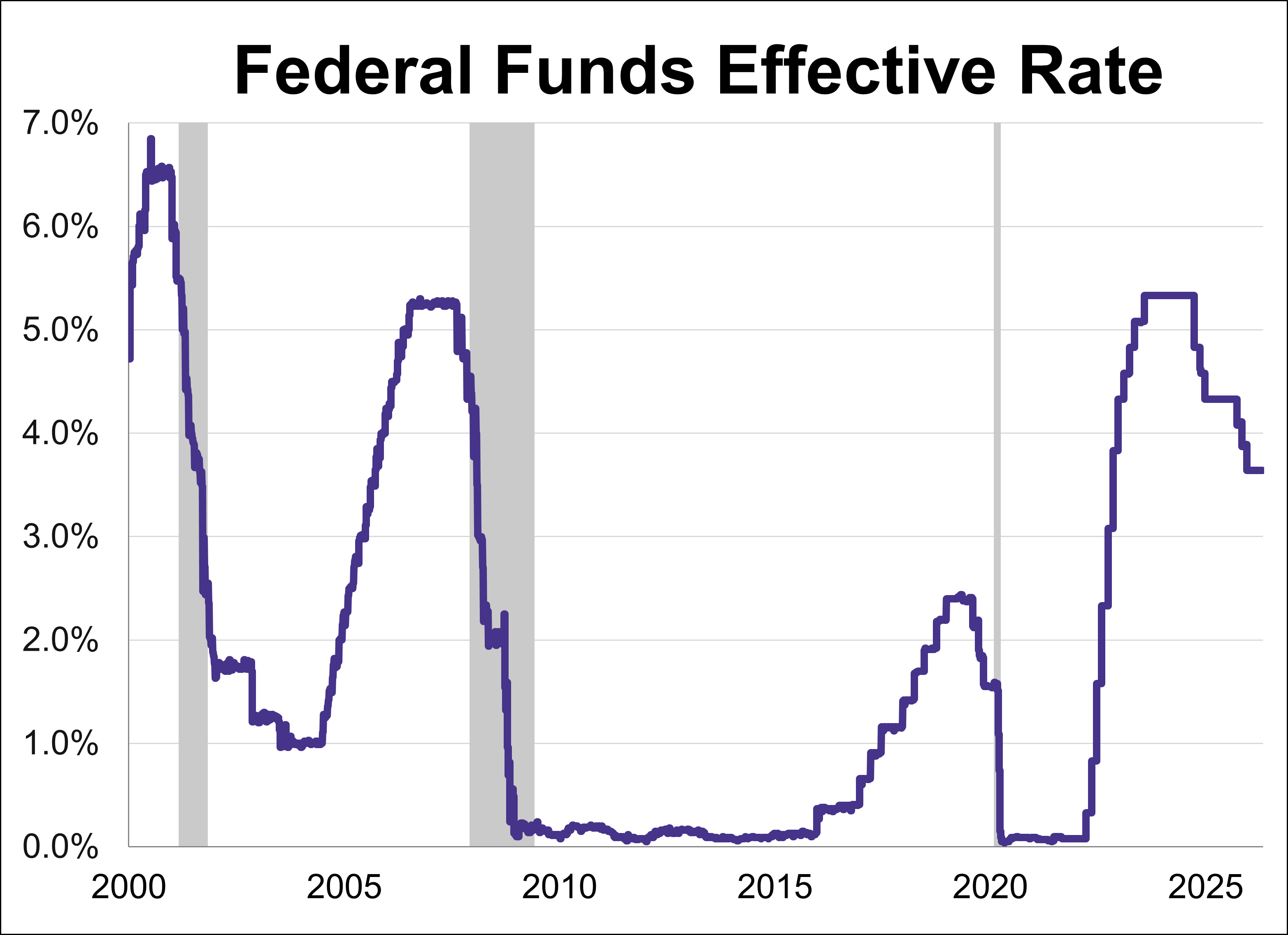
For the third consecutive policy gathering, the Federal Open Market Committee (FOMC) decided to remain ‘on hold,’ keeping the fed funds trading range at 3.50%–3.75%. This result was largely expected by the markets. Unfortunately for the Fed, the policymakers are in a challenging position of juggling incoming economic and inflation data as well as the uncertainties emanating from the Middle East war.
The U.S. stock market hit a record high on January 27, 2026, as investors prepared for additional Fed rate cuts, fiscal stimulus, and fading inflation.
The Federal Reserve concluded its third meeting of the year by holding the federal funds rate (FFR) steady in the 3.50%-3.75% range.
For many high-performing advisory teams, the challenge has never been ambition or capability. The missing ingredient has simply been an operational structure designed to support the level of success they have already surpassed. High-performing teams that tap into this reality strengthen firms from the top down and deliver exceptional service with the systems required to sustain it.
Offloading certain tasks to AI can be appealing, especially for solo advisors (or those operating with a lean team). Used effectively, it can be a time and energy-saver. But as you’re likely aware, AI tools are not perfect — they also tend to produce repetitive, generalized content that may not always resonate with your target audience.
If you read my column, you know I am a proponent of following the SHIFT format. First, get the team together to identify who you want to be as a team and what success looks like to you. Make sure everyone is headed toward the same outcome and cares about the same goals.
For much of the past few years, US Treasuries have failed to serve their traditional role as a sure-fire refuge from global market meltdowns.
Hyperliquid, the decentralized crypto exchange that has emerged as one of the most active trading venues in digital assets, is proposing to add prediction markets to its platform — a direct challenge to Kalshi and Polymarket as the fast-growing sector draws new competitors.
A quarterly report providing an in-depth analysis of the global economic landscape, key drivers and insights into fixed-income markets for investors.
Hedge fund manager turned NBA owner Gabe Plotkin, who shut his firm after a bruising showdown with meme-stock traders, is planning to convert some of his own assets into an ETF using a tactic that’s helped a slew of wealthy investors defer tax.
Here’s where I want to start, because this is the point that almost every government debt analysis, including the article we’re responding to, completely ignores. Government debt doesn’t disappear into a void. By definition, if the Government borrows capital from someone, that capital must flow somewhere.